Metropolitan Museum of Art Head of the Virgin Value
By Marcia Rackow
Special Commodity reprinted fromThe Journal of the Print World, Summertime 2003.
Fine art has been loved, treasured, and the museums these days are alluvion with people hoping to see beauty in this world—and be moved by it, as was seen in the contempo show at the Met, "Leonardo da Vinci: Main Draftsman." Simply people haven't known what Artful Realism, the philosophy founded in 1941 by the American poet and critic Eli Siegel, explains—the urgency art has for our lives!
The near important question facing every person and nation today is—How should nosotros see the globe we are in and the people close to us and far away? Aesthetic Realism shows the honest, practical answer is in aesthetics.
"The perfect piece of work of art," Mr. Siegel wrote inSelf and Globe:
"is that where the artist, while entirely himself, while a unique private, also sees an object in its abyss and precision. If it is possible; if, in fact, it is the great purpose of art to be one'south cocky and yet give everything to the object—tin we not find here the merely purpose of life itself?"
This is revolutionary! I've learned that the art way of seeing is the aforementioned equally ethics and kindness considering it is fair to the structure of the globe and every person. "All beauty," Eli Siegel stated, "is a making 1 of opposites, and the making one of opposites is what we are going after in ourselves." Studying this landmark principle opened my eyes to a new, kind, useful way of seeing art, people, the globe itself.
I learned, too, that there is something completely opposed to the art mode of seeing in us—the feeling we'll take care of ourselves, be important, through looking downwardly on everything and everybody. This is antipathy, which Mr. Siegel described as "the addition to self through the lessening of something else." Contempt is as ordinary as a wife making a sarcastic remark to her husband, and equally terrifying as a authorities'southward drive to take its fashion no matter what the facts warrant or how many people go injure.
"The merely true combatant of contempt," Mr. Siegel wrote, "is aesthetics." And opposites that are emergent for people today to make sense of are rigidity and flexibility, assertion and yielding. A person can be rigid, stubborn, and tin besides be strategically flexible in lodge to gain reward. Women do this with men, and nations exercise it with each other. We have to feel that trying to exist fair, trying to empathize the feelings of people, is strength, liberty, grand self-expression. This is what the fine art of Leonardo da Vinci shows magnificently.
1. The Flexibility that Is Also Strength
The nifty Florentine man of the Renaissance, Leonardo da Vinci, lived from 1452 to1519. As I studied his drawings in the recent exhibition at The Metropolitan Museum of Fine art and saw the scope of his work in the arts and sciences—his investigations of light and shadow, perspective, architecture, anatomy, astronomy, botany, physics, mechanics, and his writings about them, my respect and adoration grew. In his fine art, he answers a question that is raging in the earth today. What is a true relation of flexibility and compactness? Is yielding to the facts of this earth weakness or forcefulness? This is a question every person needs to answer honestly, and is crucial for every government leader.
Mr. Siegel wrote in his essay "Art as Flexibility":
Art shows reality as resisting, bending; asserting, fading—which is how it is….Yieldingness equally sight is much in pictures; the yieldingness that makes for strength is what we expect for in art.
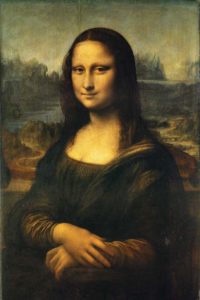
And this is what people found in Leonardo. From his earliest works we see him dealing centrally with these opposites—culminating in the peachy work that has come to stand for the art of painting itself—the Mona Lisa. "In Leonardo da Vinci," Mr. Siegel wrote, "import is got through the visual as yielding, flexible."
The power of his piece of work is in his yielding to the delicate and mighty shows of the universe. "Possessed of an unquenchable thirst for knowledge," writes the critic Robert Goldwater,
he investigated nature in all her aspects. For him art and science were 2 closely related activities, two ways for describing the concrete world. "The heed of the painter," wrote Leonardo, "should be similar a mirror which is filled with every bit many images as there are things placed before him."
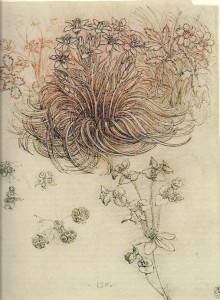
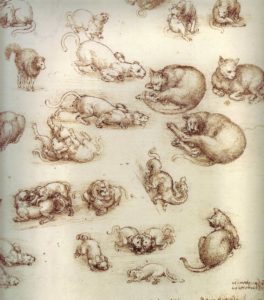
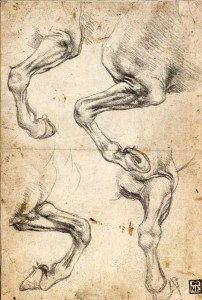
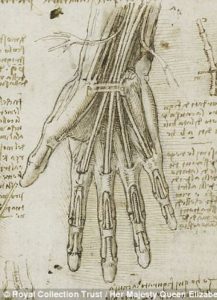
We can see this in his exquisite studies—of plants, animals, anatomy, astronomy, meteorology, ballistics.
And da Vinci writes about understanding the feelings of people:
A good painter has ii primary objects to paint: homo, and the intentions of his soul; the old is easy, the latter hard, considering he has to represent it by the attitudes and movements of the limbs.
He was interested in the range of homo emotion and expression, including the grotesque. "[Leonardo]," writes Walter Pater,
learned…the art of going deep, of tracking the sources of expression to their subtlest retreats, the power of an intimate presence.
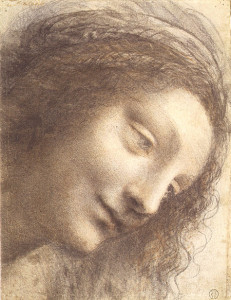
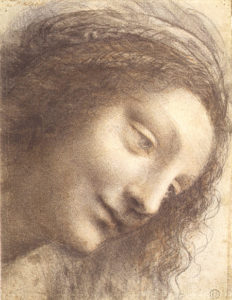
Nosotros see this in his cute drawingHead of the Virgin in Three-Quarter View Facing to the Right. While her confront has a business firm classical, sculptural quality composed of large, simple planes, there is at the same time such softness, delicacy. There is a beautiful curved movement every bit the turban encircles her face, with her hair falling in curls on the correct that give such a feeling of flexibility and yieldingness, merely this is not limp or excessive because Leonardo counters the downward motion of her head with the stiff diagonal line of her cervix from the lower left to the upper correct.
Through Leonardo's "sfumato" technique—that smoky quality—he softens the edges of things. "Da Vinci," Mr. Siegel wrote, "was later on…softening lines, making them misty, atmospheric, mysterious….The definite, the unyielding were given yieldingness, mobile gentleness." The entire limerick is a breathtaking oneness of flexibility and firmness.
2. What Can We Learn from This?
"People feel they are non flexible enough," explains Chairman of Education Ellen Reiss in The Right of Aesthetic Realism to Be Known:
"They don't encounter new things, surprises, with grace. And people despise themselves for being flexible in a bad way: ready to tailor themselves for the company they're with and for whatever tin can brand them important. Wrong flexibility is the beingness unprincipled; information technology is also moodiness. And compactness has too oftentimes been the insistence on having one's way."
These sentences describe me. I was once in a terrific fight about these opposites. In my diary I used to curse myself for being likewise yielding. I wrote: "Good old subservient, docile me. If I can but remember to ask questions, claiming, contend, maintain my integrity." And I defendant myself of: "ane. Being submissive, two. Asserting no independence."
I gave myself orders: "Be an individual who counts. Don't be that sweet jellyfish. Have a niggling courage."
What I despised myself for was the style I went afterward people's approval, and was ready to exist flexible, ingratiating, and amenable in gild to get it. I was more interested in showing how indispensable and caring I was, than in wanting to know a person, strengthen him or her. And the other side of my submissiveness was a stubbornness like a rock. I was strategic—sweet when I thought it served me, and stubborn because I thought my way was the only manner.
In an Aesthetic Realism class, Mr. Siegel spoke to me about these opposites, and asked me, in painting terms: "Practice you think curves and angles are working well in yous?" When I said, "No, I don't think so," he described the fight in me:
Marcia Rackow would similar to exist very sweetness and yielding and show how kind she is [that would exist curves], and as well be strong and evidence no 1 can take advantage of her, and that would exist angles.
And he gave form to this fight I had been in all my life, by showing me information technology was a question of fine art—and had an aesthetic solution! I needed to have 1 purpose in beingness stiff and being yielding—and that purpose was to have good volition: "the desire to have something else stronger and more cute, for this want makes oneself stronger and more beautiful." I am tremendously grateful that through my study of Artful Realism, I take been able accept this purpose increasingly in my life.
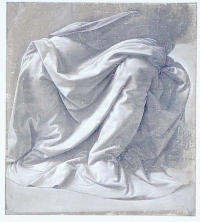
To bring out the strength and beauty of a thing is the purpose of art, and that is what nosotros see in Study of Drapery for the Legs of a Seated Figure, c. 1473. Here, curves and angles, flexibility and force are together in a way that is magnificent. The event is so sculptural it is difficult to believe it's a drawing. The cloth has such weight and volume we think we could touch it. Leonardo has captured the flexibility of the cloth, and we experience a great tenderness in information technology equally it drapes around the legs, revealing the forms underneath—the curve of the calf, the arch of the pes. We feel those legs—we experience a living person is present. Do we need—in fact, is it urgent for us—to give people and objects the depth, the solidity, the weight the artist gives to this person and these objects? Could we hurt a person we saw as having this reality, this substance, this depth?
That large curve of fabric that drapes downwards from the human knee across to the foot looks so like shooting fish in a barrel, so flexible. Though the light is strong, accenting the firmness of the legs and fabric, there is a tremendous subtlety in the gradations of light and dark. We encounter Leonardo'south love of the softening outcome of shadow every bit folds disappear into night, mysterious recesses. In this beautiful work is a guide to how we need to see other man beings.
When I was xviii, I wrote:
What is art? Do I actually intendance about the people I volition draw? Aye, but I will exist able to practise nothing for them through art. I cannot be a humanitarian. I can not modify the earth. I cannot eliminate suffering.
I say now—and it is the pride of my life—that art, fully understood and loved, tin can change the world, tin make human beings truly kinder; in fact, aesthetics is the one means to that. And that is why Artful Realism needs to be studied by people everywhere on this earth.
Marcia Rackow is an artist, and consultant on the kinesthesia of the Aesthetic Realism Foundation, a not-for-turn a profit educational foundation in New York Urban center, where she teaches the museum/gallery course The Visual Arts & the Opposites and The Art of Drawing: Surface & Depth.
guentherbelve1987.blogspot.com
Source: https://terraingallery.org/aesthetic-realism/art-criticism/is-art-really-urgently-about-life-the-drawings-of-leonardo-da-vinci/
0 Response to "Metropolitan Museum of Art Head of the Virgin Value"
Post a Comment